
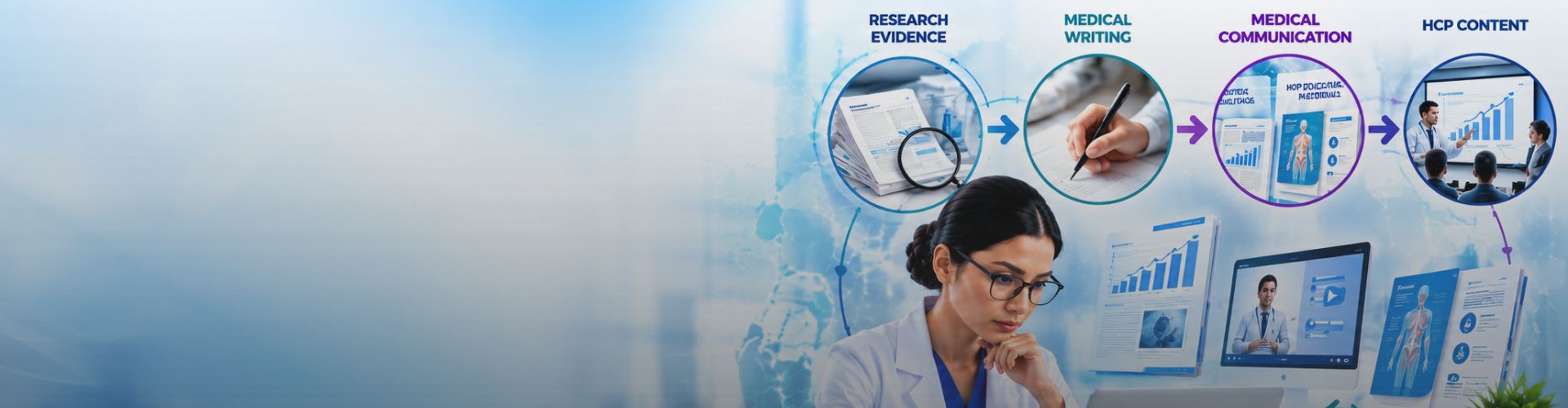
Medical research generates valuable evidence, but research findings only create meaningful impact when they are communicated clearly to the people who need them. For healthcare professionals (HCPs), scientific content must be accurate, relevant, transparent, and easy to interpret without losing the context of the underlying evidence.
This is where evidence-based medical communication plays an important role. Professional medical writers help transform clinical research, scientific literature, and medical data into structured content for healthcare professionals, including educational materials, scientific publications, clinical summaries, CME content, and other medical communication formats.
IJCP Group combines medical writing, clinical writing, medical publication, and healthcare communication capabilities to support evidence-based scientific communication.
What Is Evidence-Based Medical Communication?
Evidence-based medical communication is the process of communicating healthcare and scientific information using credible research, appropriate references, clinical evidence, and transparent interpretation.
Unlike general healthcare content, communication intended for HCPs must consider the quality and context of evidence. A medical writer needs to understand not only what a study found, but also how the study was conducted, who was studied, what its limitations were, and whether the findings can reasonably support the intended message.
The International Committee of Medical Journal Editors (ICMJE) recommends accurate, clear, reproducible, and unbiased reporting of medical research. Its current recommendations were updated in January 2026 and include guidance on AI-assisted technology in publishing.
Why Is Evidence Important in Medical Communication?
Healthcare professionals rely on scientific information to understand research developments and evaluate clinical evidence. Unsupported or exaggerated claims can therefore create confusion and undermine trust.
Evidence-based communication helps ensure that:
- Scientific claims are supported by appropriate sources
- Research findings are presented in their correct context
- Limitations are not unnecessarily omitted
- Medical terminology is used appropriately
- Complex information is presented clearly
- Educational content remains scientifically responsible
For medical writers, the objective is not to make research appear more impressive. The objective is to represent the available evidence accurately and meaningfully.
How Do Medical Writers Turn Research Into HCP Content?
Turning a research paper into useful HCP content requires a structured process.
1. Understand the Research
The first step is to understand the research question, study design, population, intervention or exposure, outcomes, results, and limitations.
A medical writer should distinguish between statistically significant findings, clinically meaningful outcomes, exploratory observations, and conclusions that remain uncertain.
2. Evaluate the Evidence
Not every piece of information has the same evidentiary value. Medical writers review relevant literature and identify appropriate primary or authoritative sources.
ICMJE guidance also emphasises the importance of accurate references and encourages authors to use appropriate original research sources where possible.
3. Identify the HCP Audience
The same research may need to be communicated differently to a specialist, general physician, pharmacist, researcher, or healthcare educator.
Understanding the audience helps determine:
- Technical depth
- Terminology
- Content format
- Level of explanation
- Relevant clinical context
4. Translate Complex Findings Clearly
A medical writer converts complex scientific information into a logical narrative without changing its meaning.
This may involve developing:
- Clinical summaries
- Scientific articles
- Medical education materials
- HCP educational content
- Conference abstracts
- Scientific presentations
- Medical CME content
- Publication materials
IJCP Group's medical writing services include scientific and clinical content, peer-reviewed publications, CME materials, clinical trial manuscripts, regulatory documents, and patient education content.
5. Review and Validate the Content
Before publication or distribution, content should undergo appropriate editorial, scientific, and compliance review.
This step is particularly important when content includes clinical recommendations, treatment information, safety data, comparative claims, or interpretations of research findings.
How Does Medical Communication Support HCP Education?
Effective medical communication helps healthcare professionals stay informed about emerging evidence, clinical research, treatment developments, and scientific knowledge.
Medical CME is one important application. Medical writers can help convert evidence into structured learning resources such as educational modules, clinical cases, presentations, assessment questions, and scientific summaries.
The value of CME content depends on more than presentation. The underlying evidence, educational objective, audience relevance, and appropriate review process all matter.
What Role Does AI Play in Medical Communication?
AI can support medical writing workflows by helping organise information, summarise literature, refine language, and develop preliminary content structures.
However, AI-generated text should not automatically be treated as scientifically accurate. Human experts remain important for evaluating evidence, identifying missing context, checking references, interpreting clinical findings, and ensuring responsible communication.
The January 2026 ICMJE recommendations now include a dedicated section on the use of AI in publishing, reinforcing the importance of responsible human involvement in scholarly communication.
Why Choose IJCP Group for Medical Communication?
For healthcare and pharmaceutical organisations, effective medical communication requires a combination of scientific understanding, writing expertise, editorial discipline, and healthcare-industry knowledge.
IJCP Group provides integrated support across Medical Writing, Clinical Writing, Medical Publication, Medical Communication, and Medical CME, helping organisations develop structured, evidence-based content for professional audiences.
The focus is not simply on producing more content. It is on developing communication that is accurate, evidence-based, audience-appropriate, and ethically responsible.
Conclusion
Research creates evidence; effective medical communication helps that evidence reach its intended audience.
From clinical research and scientific publications to clinical writing, medical CME, and HCP education, medical writers play an important role in translating complex information into clear and useful communication.
As healthcare communication becomes increasingly digital and AI-assisted, the fundamental principles remain the same: credible evidence, accurate interpretation, transparency, and expert review.
For organisations seeking professional support in this area, IJCP Group brings together medical writing and broader healthcare communication capabilities to help transform scientific evidence into meaningful HCP content.
Frequently Asked Questions
What is evidence-based medical communication?
It is the communication of medical and scientific information using credible evidence, appropriate references, transparent interpretation, and audience-focused presentation.
How do medical writers support HCP communication?
They transform clinical research and scientific evidence into structured content such as medical publications, clinical summaries, CME materials, scientific presentations, and educational resources.
What is the difference between medical writing and medical communication?
Medical writing focuses primarily on developing accurate medical and scientific content, while medical communication encompasses the broader strategy and delivery of scientific information to healthcare audiences.