
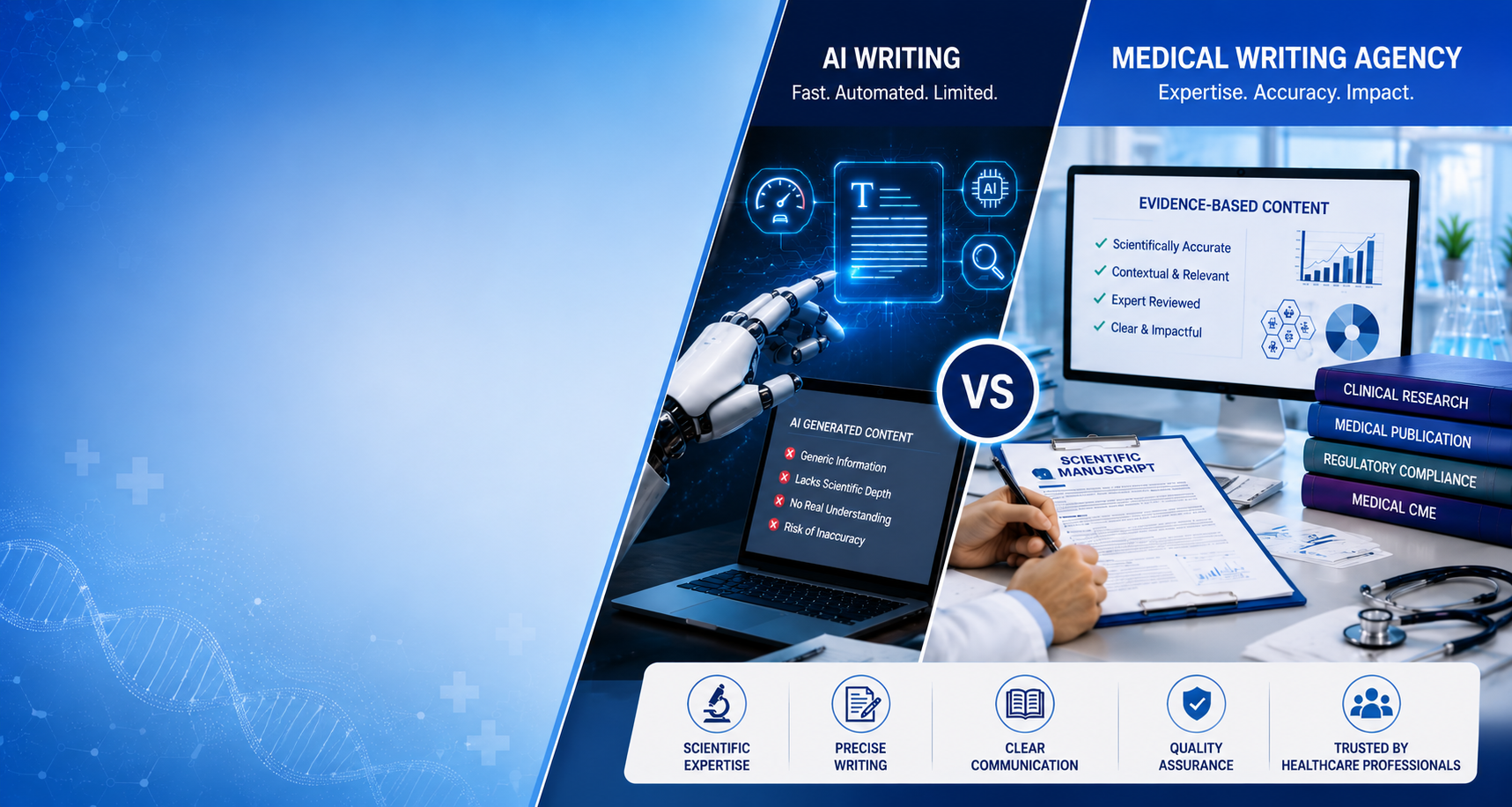
Artificial intelligence is rapidly changing how information is researched, drafted, summarized, and edited. In healthcare, AI tools can help professionals manage large volumes of information and accelerate routine content tasks.
But when the subject is medical research, clinical evidence, scientific publications, or healthcare education, producing text is only one part of the job.
This raises an important question: Should organizations rely on AI writing alone, or work with a professional medical writing agency?
The strongest approach is not necessarily about choosing technology over people. It is about understanding where AI can improve efficiency and where human scientific expertise remains essential.
What Is the Difference Between AI Writing and an Agency?
AI writing tools generate content based on patterns learned from large datasets. They can produce drafts, summarize information, restructure sentences, and assist with language refinement.
A professional medical writing agency works differently. It combines scientific knowledge, medical writing expertise, editorial review, research understanding, and audience awareness.
For example, an AI tool may generate a summary of a clinical study. A professional team can go further by evaluating the study design, interpreting the findings in context, checking whether claims are supported by evidence, and presenting the information appropriately for its intended audience.
That distinction becomes important when accuracy and scientific credibility are priorities.
Why Is Human Expertise Important in Medical Writing?
Healthcare content cannot be evaluated only by whether it sounds professional.
Scientific information needs context.
A medical writer may need to understand:
- Study objectives and methodology
- Clinical outcomes
- Statistical findings
- Relevant scientific literature
- Research limitations
- Publication requirements
- Intended readership
- Ethical considerations
An experienced professional can identify whether a statement accurately represents the available evidence and whether a conclusion goes beyond what the research actually demonstrates.
AI can assist with language, but scientific judgment remains a human responsibility.
Can AI Replace a Medical Writing Agency?
AI can automate parts of the writing workflow, but replacing an experienced agency entirely presents challenges.
For scientific and healthcare content, organizations may require more than drafting. They may need research interpretation, content strategy, scientific review, editorial quality control, publication guidance, and collaboration with subject-matter experts.
A professional agency can coordinate these activities as part of one workflow.
This is especially relevant for organizations developing research manuscripts, educational materials, scientific documents, or publication content where errors can affect credibility.
Medical Paper Writing Requires Scientific Understanding
A research manuscript is not simply a collection of information.
Medical Paper Writing requires a logical scientific narrative connecting the research question, methodology, results, discussion, and conclusions.
An experienced writing team can help researchers communicate their findings clearly while preserving the original scientific meaning.
AI may help create an initial draft or improve sentence structure, but human review is essential for checking scientific accuracy, interpretation, terminology, and consistency.
The objective should always be to communicate the evidence—not make the evidence appear stronger than it is.
Why Does Medical Publication Need Professional Oversight?
Scientific publication involves several stages beyond writing.
A manuscript may need to be aligned with journal requirements, reviewed for consistency, supported by appropriate references, and prepared for submission. Researchers may also need assistance responding to editorial or peer-review comments.
Professional Medical Publication support can help organize these activities and improve publication readiness.
However, no agency can legitimately guarantee journal acceptance. Editorial decisions depend on the quality, relevance, methodology, originality, and suitability of the research, as well as the peer-review process.
Where Can AI Add Value?
The comparison does not have to be AI vs agency.
AI can be extremely useful when appropriately supervised.
It can assist with:
Information organization: Helping structure large amounts of material.
First drafts: Creating an initial framework for content.
Language refinement: Identifying grammatical or readability issues.
Summarization: Condensing information for review.
Workflow efficiency: Reducing time spent on repetitive tasks.
The important factor is what happens after AI generates the content.
Scientific claims, references, data interpretation, terminology, and clinical context should be reviewed by qualified professionals before publication or professional use.
The Better Model: AI-Assisted Human Expertise
A modern medical writing agency can use AI as a supporting technology rather than treating it as a replacement for professional expertise.
The workflow can be viewed simply:
AI → Speed and efficiency
Medical writers → Scientific interpretation and communication
Subject-matter experts → Clinical validation
Editors → Quality and consistency
Final human review → Accuracy and accountability
This combination allows organizations to benefit from technological efficiency while maintaining the standards expected from healthcare and scientific communication.
What About Medical CME?
The same principle applies to Medical CME content.
Continuing medical education materials need to be accurate, evidence-based, relevant, and appropriately designed for healthcare professionals. AI can help with initial organization and drafting, but educational objectives, scientific interpretation, clinical relevance, and final accuracy require expert oversight.
Professional teams can also work with subject-matter experts to ensure that educational content reflects current evidence and is appropriate for the intended healthcare audience.
Why Choose IJCP Group?
IJCP Group brings together healthcare communication, medical writing, scientific publication, medical education, and CME capabilities.
Its approach recognizes that AI can make content workflows faster, while experienced professionals provide the scientific judgment required to make healthcare information meaningful and reliable.
For organizations working on Medical Writing, Medical Paper Writing, Medical Publication, and Medical CME, this integrated approach can provide a balance between modern technology and human expertise.
The value of an experienced agency is therefore not simply in producing words. It lies in understanding what should be communicated, why it matters, how the evidence should be presented, and who needs to understand it.
The Future of Medical Writing Is AI + Expertise
AI will continue to become more capable, and its role in scientific communication will likely expand.
But healthcare organizations should look beyond speed.
Scientific communication requires accuracy, context, transparency, ethical judgment, and accountability. These are areas where qualified professionals remain critical.
The future is therefore unlikely to be AI versus medical writers.
It is more likely to be:
AI for efficiency. Experts for accuracy. Agencies for strategic execution.
For organizations that cannot compromise on scientific quality, partnering with an experienced medical writing agency can provide the human oversight needed to turn AI-assisted workflows into credible healthcare communication.
Frequently Asked Questions
Can AI write medical content?
Yes. AI can generate and assist with medical content, but qualified human review is important to verify scientific accuracy, references, context, and interpretation.
Why use a medical writing agency when AI tools are available?
An agency provides scientific expertise, editorial oversight, research understanding, publication knowledge, and strategic communication support that goes beyond automated text generation.
Can AI replace medical writers?
AI can automate certain tasks, but it does not eliminate the need for human scientific judgment, clinical context, ethical review, and accountability.
Is AI useful for medical publications?
Yes, when used responsibly. AI can support drafting, organization, and language refinement, while experts should verify the final scientific content.
Why is IJCP Group relevant in the AI era?
IJCP Group combines healthcare expertise with medical writing, scientific publication, medical education, CME, and healthcare communication capabilities, enabling organizations to use technology while retaining professional human oversight.