
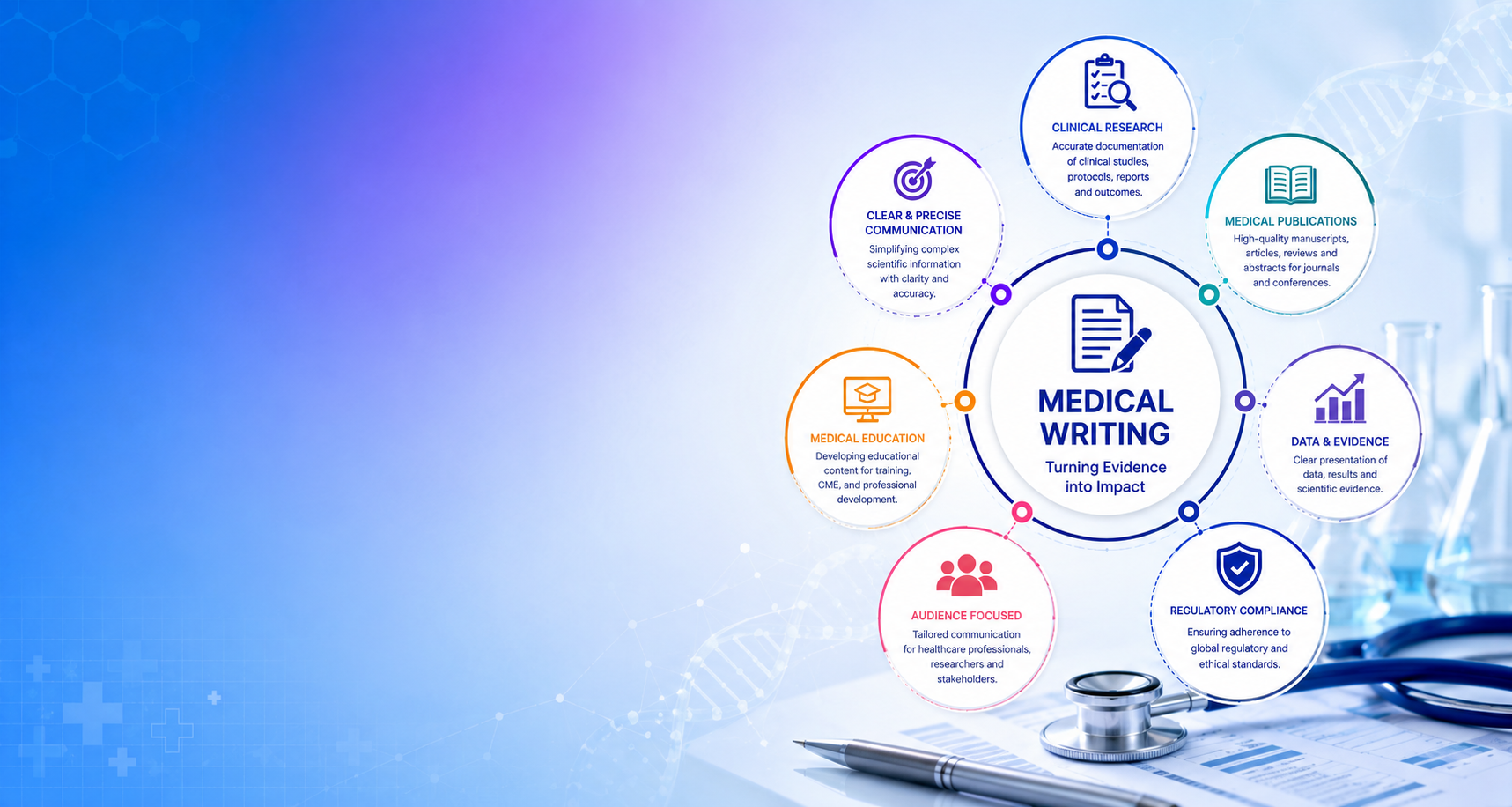
Healthcare research produces an enormous amount of scientific information every year. Clinical studies, laboratory research, pharmaceutical development, and academic investigations all contribute to medical knowledge. However, research findings need to be communicated clearly before they can be understood and used by the wider healthcare community.
This is where Medical Writing plays an important role. It helps convert complex scientific information into structured, accurate, and audience-appropriate documents for researchers, healthcare professionals, pharmaceutical organizations, academic institutions, and scientific publications.
What Is Medical Writing?
Medical writing is a specialized form of scientific communication focused on medical, clinical, pharmaceutical, and healthcare-related information. It combines knowledge of medical science with structured writing, evidence evaluation, and editorial skills.
Unlike general content writing, this field requires an understanding of scientific terminology, research methodology, clinical data, publication standards, and ethical communication.
Medical writers may contribute to different types of documents, including:
- Research manuscripts
- Review articles
- Case reports
- Clinical research documents
- Conference abstracts
- Scientific posters
- Medical education materials
- Healthcare information resources
- Publication-related documents
The purpose is to communicate research accurately without changing the meaning or significance of the evidence.
Why Is Medical Writing Important in Healthcare Research?
Research findings can be difficult to interpret when large amounts of technical information are presented without a logical structure. Professional scientific communication helps organize this information so that readers can understand the research question, methodology, results, limitations, and conclusions.
Good writing can improve:
- Clarity of scientific information
- Logical organization
- Consistency of terminology
- Presentation of research findings
- Readability of technical documents
- Understanding among professional audiences
The objective is not to make scientific findings appear more impressive. Instead, the focus should be on representing the evidence accurately and transparently.
How Does Clinical Writing Support Research?
Clinical research involves detailed information about study design, patient populations, methodology, outcomes, safety findings, and statistical analysis.
Clinical Writing focuses specifically on communicating information generated during clinical research and related activities. Depending on the project, this can involve clinical study documentation, research reports, manuscripts, abstracts, and other scientific materials.
An effective clinical document should clearly explain what was studied, how the study was conducted, what the results showed, and what limitations should be considered.
Because clinical information can be complex, accuracy and consistency are particularly important throughout the documentation process.
What Is the Connection Between Medical Writing and Medical Publication?
Research becomes more widely accessible when it is appropriately published and disseminated. Medical Publication involves the broader process of preparing and communicating scientific research through journals, conferences, and other professional channels.
Writing is an important part of this process, but publication involves several additional considerations, such as:
- Identifying an appropriate publication
- Understanding author guidelines
- Preparing the manuscript
- Reviewing references and supporting evidence
- Ensuring appropriate ethical disclosures
- Submitting the manuscript
- Responding to editorial or peer-review comments
A professionally prepared manuscript can make scientific information easier for editors, reviewers, and readers to assess. However, publication acceptance ultimately depends on the journal's editorial and peer-review process.
Medical Writing vs. General Content Writing
Although both involve written communication, their objectives and requirements are different.
General content writing may focus on engagement, readability, marketing, or brand communication. Medical writing, on the other hand, places greater emphasis on scientific accuracy, evidence, terminology, research context, and ethical considerations.
For example, a healthcare article intended for the general public may require simplified explanations, while a clinical research manuscript requires technical detail and a formal scientific structure.
Understanding the intended audience is therefore an essential part of the writing process.
What Skills Does a Medical Writer Need?
A capable medical writer typically requires a combination of scientific and communication skills.
Important capabilities include:
Scientific understanding: Ability to understand research concepts and medical terminology.
Research skills: Ability to review and interpret relevant scientific literature.
Writing ability: Capacity to communicate complex information clearly.
Critical thinking: Ability to distinguish evidence-based findings from unsupported conclusions.
Attention to detail: Accuracy in terminology, references, data, formatting, and consistency.
Ethical awareness: Understanding of responsible scientific communication and publication practices.
These skills enable writers to work effectively with researchers, clinicians, editors, and other subject-matter experts.
How Is Artificial Intelligence Changing Medical Writing?
Artificial intelligence is becoming increasingly relevant to scientific and healthcare communication. AI tools can assist with tasks such as summarization, information organization, language refinement, and initial content structuring.
However, healthcare information requires careful human review. AI-generated content can contain factual errors, inappropriate interpretations, unsupported claims, or inaccurate references.
For this reason, AI should be viewed as a supporting technology rather than an automatic replacement for scientific expertise. Human professionals remain essential for evaluating evidence, context, clinical meaning, ethics, and the final accuracy of scientific content.
What Should Organizations Consider When Selecting a Medical Writing Partner?
Organizations looking for professional support should consider more than price or turnaround time.
Useful evaluation criteria include:
- Relevant scientific expertise
- Experience with the required document type
- Knowledge of publication practices
- Quality-control procedures
- Evidence and reference verification
- Confidentiality processes
- Editorial capabilities
- Understanding of ethical standards
A credible provider should communicate its capabilities transparently and should never guarantee publication acceptance.
The Role of IJCP Group in Healthcare Communication
IJCP Group operates across medical publications, healthcare communication, medical education, CME initiatives, and scientific content development.
Its healthcare-focused capabilities support organizations and professionals that need to communicate medical and scientific information across publications, education, and professional communication channels.
By combining healthcare knowledge with communication expertise, IJCP Group aims to help make complex medical information clearer, structured, and relevant to professional audiences.
What Is the Future of Medical Writing?
The future of scientific communication is likely to involve greater integration of technology, digital publishing, artificial intelligence, clinical research, and online medical education.
However, technology does not remove the need for scientific responsibility. Accuracy, evidence, transparency, expert review, and ethical communication will continue to be fundamental to high-quality healthcare content.
As research becomes increasingly complex, the ability to communicate scientific evidence clearly will remain an important part of the healthcare ecosystem.
Frequently Asked Questions
What is Medical Writing?
Medical writing is the specialized communication of medical, clinical, pharmaceutical, and scientific information through documents designed for professional or educational purposes.
What is Clinical Writing?
Clinical writing focuses on documentation and communication related to clinical research, clinical studies, and associated scientific information.
What is Medical Publication?
Medical publication is the process of preparing and disseminating medical and scientific research through journals, conferences, and other recognized professional channels.
Who uses Medical Writing?
Researchers, pharmaceutical companies, hospitals, universities, biotechnology organizations, medical associations, and healthcare professionals may use specialized scientific writing.
Can AI replace medical writers?
AI can assist with certain writing and research tasks, but expert human review remains important for scientific accuracy, evidence interpretation, ethics, and clinical context.
Why is scientific accuracy important?
Accurate communication ensures that research findings are represented according to the available evidence and reduces the risk of misleading readers.